Chaco For Ever vs Club Atlético Colón Lineup Impact: How Formations Decided the Primera Nacional Outcome
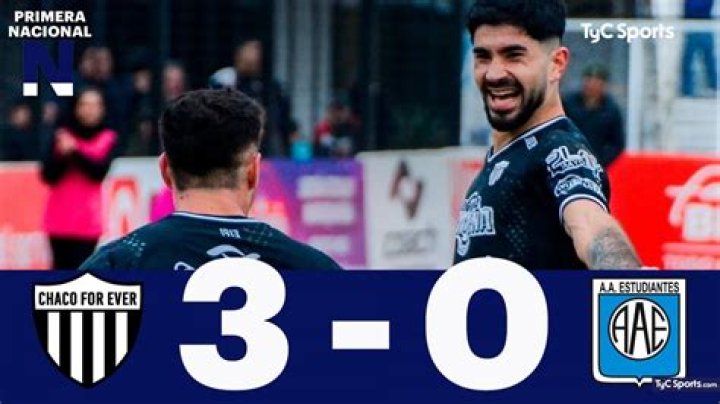
In a contest that crackled with tactical intrigue from the very first whistle, Chaco For Ever vs Club Atlético Colón delivered a masterclass in formation warfare within the Primera Nacional — a match where the decisions made in the coaching dugout proved every bit as decisive as the boots on the pitch. One goal. One moment. One name etched into the drama: A. Ojeda, whose strike off the left flank silently screamed the story of an entire tactical blueprint coming to life.
The Fortress vs The Swarm: How Two Formations Set the Stage
Before a single blade of grass was disturbed, the battle lines were drawn in ink on two team sheets — and what contrasting philosophies they revealed. Santiago Ojeda's Chaco For Ever arrived draped in black, deploying a resolute 5-4-1 system that screamed defensive intent from its very architecture. Five defenders stacked across the backline. Four industrious midfielders tasked with suffocating space. One lone striker left to hunt any scrap that came his way. It was a formation built not to dominate — but to survive, strangle, and strike.
Across the technical area, Argentine tactician Ezequiel Luis Medrán answered with something far more expansive and adventurous: a sweeping 3-5-2 formation for Club Atlético Colón, dressed in white. Three centre-backs providing the structural base. Five midfielders flooding every corridor of the pitch. Two forwards pressing in tandem, hunting in pairs like wolves at the door. On paper, Colón's system demanded more of the ball, more territory, more momentum. The question that hung in the air like thunderclouds over the Chaco region was brutally simple — could Colón's numerical midfield advantage crack open For Ever's iron-clad defensive shell?
Chaco For Ever's 5-4-1: The Architecture of Defensive Suffocation
What Santiago Ojeda constructed was not a defensive structure built from fear — it was a calculated, ruthless tactical weapon. G. Canuto stood between the posts wearing the yellow-and-black goalkeeper kit, the last sentry of a fortress that had no intention of opening its gates willingly.
The Five-Man Defensive Wall
In front of Canuto, five defenders formed a human barricade that would test Colón's every attacking impulse. D. Valdez anchored the right side at number 2, while M. Silvera (3) and the imposing L. Mihovilcevich (4) held the central positions with physicality and discipline. R. Garay (6) patrolled the left-centre channel, but perhaps the most intriguing piece of this defensive puzzle was A. Ojeda at number 11 — listed as a defender, but positioned on the left flank with a forward's hunger. That ambiguity would prove prophetic. It was Ojeda who registered the solitary goal of this match, a moment that vindicated the entire tactical philosophy: defend deep, wait patiently, and then strike with lethal precision when the moment arrives.
The Midfield Shield and the Solitary Striker
Behind striker I. Enriquez — a lone figure tasked with an almost gladiatorial role at number 9 — the midfield four of B. Nievas (5), B. Guerra (7), J.C. Cerrudo (8), and A. Lioi (10) formed a relentless pressing unit. Their job was not to create spectacle. Their job was to win the ball, recycle it efficiently, and deny Colón's five-man midfield the rhythmic possession they craved. In that suffocating function, they largely succeeded. Enriquez, stripped of service for long stretches, remained a persistent nuisance — a constant threat through sheer willingness to run channels that Colón's defensive trio struggled to track under pressure.
Club Atlético Colón's 3-5-2: The Expansive Bid That Fell Short
Medrán's vision was bold, almost romantically so. The 3-5-2 was designed to flood the midfield and overwhelm For Ever's compact block through sheer numerical superiority in the engine room. M. Budino, donning the gold-and-yellow goalkeeper kit, anchored the rear. Before him, M. Peinipil (4), S. Olmedo (2), F. Rasmussen (6), and L. Allende (3) composed a four-man defensive unit operating within a three-centre-back framework — Allende functioning as a marauding left-sided defender with licence to push forward.
The Five-Midfielder Engine: Promise That Couldn't Unlock the Door
The heartbeat of Colón's system lived in its midfield five. F. Lértora (5) served as the deep-lying conductor. I. Antonio (8) brought box-to-box energy. D. Sarmiento (7) and J. Marcioni (11) provided width on the flanks, tasked with stretching For Ever's five-man defensive line and creating pockets of space through overlapping runs. I. Lago (10) — the creative fulcrum wearing the number ten — was the man designated to thread passes between those pockets, to be the knife that cut through black cotton.
Yet For Ever's 5-4-1 denied Lago and his midfield partners the open terrain they needed. Every time Colón's engine threatened to ignite, For Ever's midfield quartet dropped to form a secondary defensive line, creating an almost impenetrable double-block that suffocated Lago's creativity before it could breathe. The 3-5-2 needs space between the lines to function — and space was the one commodity Ojeda's men flatly refused to surrender.
The Twin Strikers: Bonansea Isolated
A. Bonansea (9) led the line with commendable tenacity alongside the midfield-forward hybrid runners, but the brutal truth was this — without Lago firing creative passes through the lines at pace, Bonansea spent the match wrestling with Mihovilcevich and Garay in a physical battle that For Ever's defensive giants relished. The 3-5-2's theoretical superiority in attack never translated into the cutting-edge moments that could have altered the scoreline.
The Substitutions: Where the Tide Was Tested and Confirmed
No tactical assessment of this match is complete without a piercing examination of the substitution decisions — moments where both coaches attempted to rewrite the story already being authored on the pitch.
For Ever's Substitutions: Managing the Lead with Precision
Santiago Ojeda moved with the confidence of a man who trusted his structure implicitly. B. Guerra (7) and J.C. Cerrudo (8) were withdrawn at the 73rd minute, having served their purpose as tireless midfield workers in the suffocation game. In came E. Gaggi (17, midfielder) and E. Pacheco (20, forward) — a dual injection that simultaneously reinforced For Ever's midfield press while adding a second attacking outlet to relieve pressure on the increasingly isolated Enriquez. This was not a defensive substitution. This was a statement of controlled aggression: For Ever intended to maintain their attacking threat, not retreat into a purely reactive shell.
A. Lioi's withdrawal at the 84th minute was replaced by B.B. García (18, midfielder), adding six minutes of fresh legs to a midfield that had worked tirelessly. The late introduction of T. Chamorro (13, defender) in the dying seconds — accumulating just one recorded minute — was the final tactical seal on For Ever's defensive fortress, a signal to Colón that the door was firmly, irrevocably shut.
Colón's Substitutions: The Desperate Gambit That Arrived Too Late
Medrán's hand was forced. With the scoreline against his team, he unleashed a triple substitution at the 79th minute — withdrawing L. Allende (3), F. Lértora (5), and I. Antonio (8) simultaneously, replacing them with C. Ibarra (16, defender), M. Muñoz (20, midfielder), and M. Ingravidi (14, forward). The triple change was dramatic in its ambition — particularly the introduction of Ingravidi, a forward thrust into the mix to add a third attacking presence alongside Bonansea.
Yet the timing, for all its drama, felt like a confession. The triple change came in the 79th minute — an acknowledgment that Colón's original plan had failed to yield dividends in the first three-quarters of the contest. Fresh forward energy arrived too late to dismantle what For Ever had spent the entire match carefully constructing. D. Sarmiento followed at the 84th minute, replaced by J. Buosi (18, forward) — another attacking card thrown into an increasingly desperate poker hand. But For Ever's black-shirted wall held firm, impenetrable and resolute to the final whistle.
Tactical Verdict: The 5-4-1 Triumphed Where the 3-5-2 Stumbled
The final analysis writes itself with a clarity that is almost brutal in its simplicity. Chaco For Ever's 5-4-1, under the astute guidance of Santiago Ojeda, proved perfectly calibrated against Colón's expansive 3-5-2. Where Colón's midfield five sought to dominate territory and possession, For Ever's compact double-block strangled the creative pathways. Where Colón's twin forwards sought service through the lines, For Ever's five-man defence consumed every thread Lago attempted to weave.
And at the singular, devastating moment when A. Ojeda — that ambiguous left-flank defender with a forward's instinct — found the net, the entire tactical narrative crystallized. One goal. Born from structural discipline. Executed by a man playing a position that defied simple categorization. The goal was, in many ways, the formation itself made flesh — a system that defended with five but attacked through the unexpected, the unscripted, the unpredictable.
Colón's substitutions told the story of a formation that needed more time, more space, and more rhythm than For Ever's suffocating structure would ever permit. The 3-5-2 is a system of ambition — but ambition without the oxygen of open space is nothing more than a beautiful, breathless theory. On this occasion, against this fortress, that theory was dismantled one blocked passing lane at a time.
For the latest confirmed lineups, live match analysis, and Primera Nacional 2026 tactical breakdowns, visit StreamPitch at worldcup2026.fsb.gov.ng — your definitive destination for South American football intelligence.
